
9 Best SEO Tools in 2026 (Ranked for Indie Hackers)
The 9 best SEO tools in 2026, ranked for indie hackers — why first-party GSC data beats Semrush and Ahrefs estimates, with dated pricing and honest limits.
 Ayush Chaturvedi11 min read
Every "best SEO tools" listicle on the internet puts Ahrefs and Semrush at the top. Ahrefs starts at $129/month. Semrush starts at $139.95/month. And here's the part those listicles skip: neither tool knows how much traffic your site actually gets.
They estimate it. Ahrefs ran its own study across 1,635 websites, comparing its traffic estimates against real Google Search Console data — the median deviation was 49.52%. A separate 184-site study by Collaborator.pro put Ahrefs' error rate at 48.63% (it tends to underestimate) and Semrush's at 61.58% (it tends to overestimate — in one case reporting ~134K visits for a site whose real traffic was around 50K).
For small sites — which is what almost every indie hacker runs — it's worse. Below ~10K monthly visits, panel data gets statistically thin, and these tools will happily show "zero traffic" for a site that Google Search Console says gets thousands of impressions.
Here's the thing - you already own the best data in the business. Google Search Console shows the actual queries, impressions, clicks, and positions Google served for your site. It's first-party, it's free, and it's ground truth instead of a guess.
So this list is built differently. I ranked the 9 best SEO tools in 2026 for indie hackers, first-party data first — tools that read your real GSC and GA4 numbers, then third-party tools only where they're genuinely worth paying for. My top pick is CrawlRaven — it connects Search Console and GA4, imports your keyword research, and hands back one ranked plan of what to write, update, and fix. It has a free plan for one site, and its lifetime deal starts at $39 one-time.
Let's get into it👇
How I ranked these🧐
"Best SEO tool" and "best SEO tool for a solo founder" are different lists. Most rankings score feature checklists for agency teams. I scored for someone building one or a few sites with nights-and-weekends time and a real budget. Four criteria:
- First-party data first — does the tool read your actual GSC/GA4 data, or does it model guesses from rankings and clickstream panels? Guesses ranked lower by default.
- Cost at solo scale — $139/month is $1,679/year before you've earned a dollar from SEO. Free tiers, one-time pricing, and lifetime deals carry real weight here.
- Time-to-first-result — a solo founder doesn't want a dashboard to stare at. They want to know what to do this week.
- Honest precision — tools that display estimates as if they were measurements lost points. Say what the number is.
All prices below are current as of September 2026 and dated as such. SEO pricing moves fast — check before you buy.
Quick comparison table📋
| Tool | Best for | Price (September 2026) |
|---|---|---|
| CrawlRaven | Turning your GSC + GA4 data into one ranked to-do list | Free (1 site) · Lifetime from $39 one-time |
| PikaSEO | Free on-page and content tooling — 40+ tools, no signup | Free |
| Google Search Console | The first-party foundation every site needs | Free |
| SEOgets | GSC + GA4 dashboards across many sites | Free · Core $39/mo · Pro $49/mo |
| SEOTesting | Proving which changes actually moved traffic | 14-day trial · $50/mo (1 site) |
| Screaming Frog | Deep technical crawls past 500 URLs | Free (500 URLs) · £199/yr (~$279) |
| Ahrefs Webmaster Tools | Real backlink data on your own site for $0 | Free (your sites only) |
| Ahrefs | Competitor and backlink research (third-party) | Starter $29/mo · Lite $129/mo |
| Semrush | All-in-one suite for funded teams (third-party) | Pro $139.95/mo |
1. CrawlRaven — your Search Console data turned into a to-do list🏆
The only tool on this list that joins your GSC performance, GA4 behavior, imported keyword lists, and a site crawl — and hands back one ranked plan instead of another dashboard.
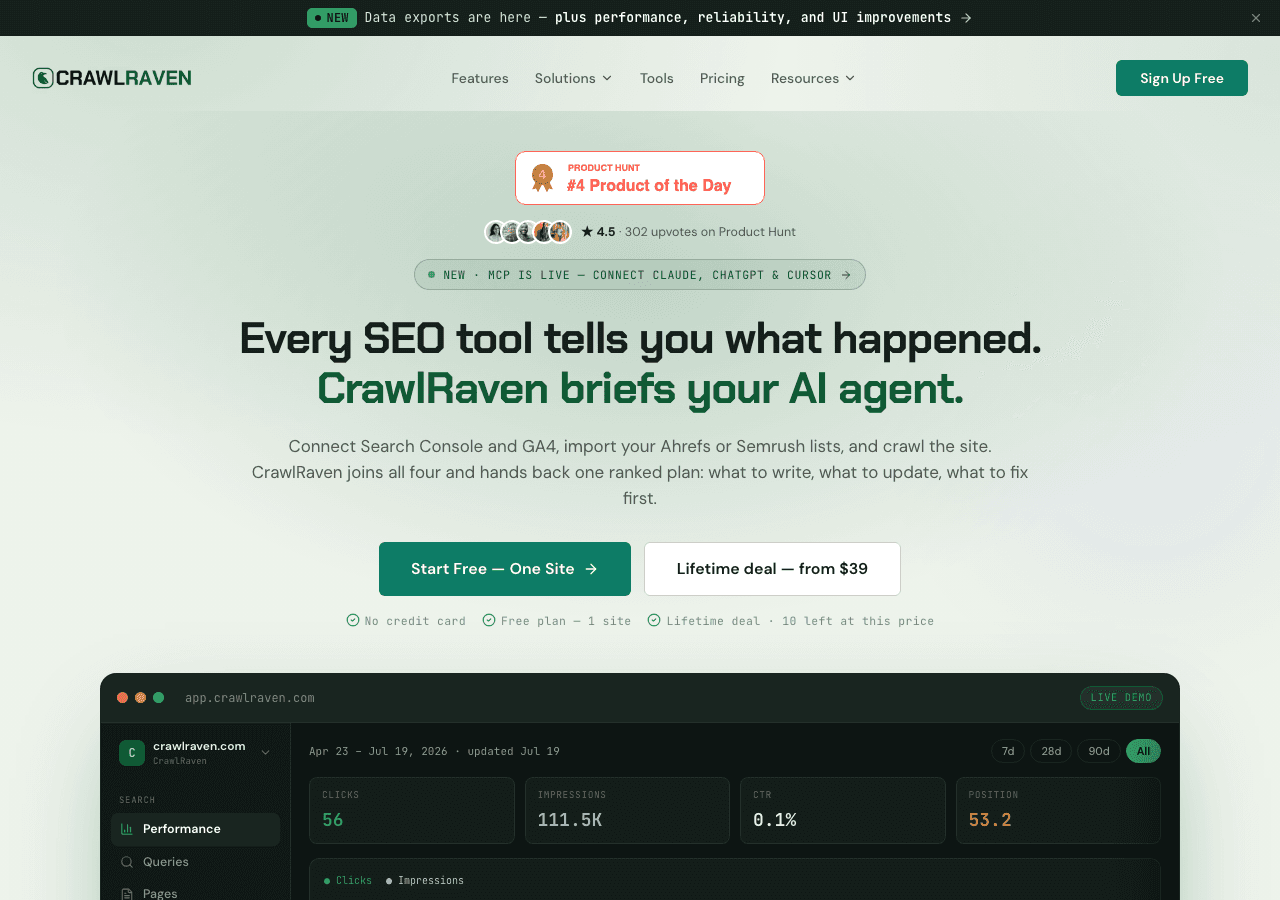
CrawlRaven exists because of a problem every SEO eventually hits: GSC shows what changed, GA4 shows what visitors did about it, Ahrefs shows what you could rank for, and your crawler shows what's broken — four tools, four exports, and the actual strategy living in a spreadsheet nobody opens. CrawlRaven connects all four with one-click OAuth, syncs daily, and ranks the output: what to write, what to update, what to fix first.
The differentiators that earned it the top spot for indie hackers:
- Striking-distance wins — queries sitting between position 8 and 20, ranked by impressions, mapped to the page that already ranks. These are the fastest wins in SEO and GSC shows them to you for free; CrawlRaven just surfaces them without regex gymnastics.
- Cannibalization flags — when two of your URLs compete for the same query and split the clicks, it tells you to consolidate or differentiate before rankings tear.
- Decay alerts — pages quietly losing clicks get flagged while it's still a dip, not a crater.
- It's honest about third-party data — CrawlRaven is not a keyword research tool. You bring your keyword CSVs (from Ahrefs, Semrush, anywhere); it merges them with GSC discoveries into one keyword-to-page map.
It also ships a remote MCP server, so Claude, ChatGPT, or Cursor can query your Search Console evidence and your ranked plan over OAuth instead of inventing context — genuinely useful if you're doing the AI-assisted-SEO thing in 2026. And there's a free Chrome extension for on-page audits: meta tags, JSON-LD schema validation, hreflang, redirect chains, and broken links from a side panel on any page.
Full disclosure: CrawlRaven comes from our own ecosystem, so hold it to the same bar as everything else here — the launch receipts are public. It hit #4 product of the day on Product Hunt on July 23, 2026 with 302 upvotes, and the site counts 500+ SEO professionals on it.
Pricing (September 2026): a free plan covers one website with GSC insights and keyword/page performance, no credit card. Paid plans are lifetime deals, not subscriptions: $39 one-time for 1 site, $79 for 3 sites, $129 for 10 sites. Licenses sell in batches of 10 and the price steps up with each batch — at publish time, batch 4 had 10 licenses left at $39/$79/$129, with the next batch at $49/$89/$139. Your price locks forever.
Do the math against the subscription alternatives: SEOTesting is $50/month — that's $600/year, every year, for one site. CrawlRaven's $39 lifetime license is about three weeks of SEOTesting, paid once.
Best for: Solo founders and small teams who want SEO to arrive as a weekly to-do list, built from their own data, without renting a dashboard forever.
Watch out: It's a young product (launched 2026) with fewer third-party reviews than tools that have been around a decade, and the 200-point technical audit tier is still rolling out across plans — check what's live for your tier before buying for the crawler specifically.

2. PikaSEO — the free on-page workbench✨
40+ AI-powered SEO tools with no signup, no account, and no usage limits — the fastest way to do the on-page work your GSC data tells you to do.
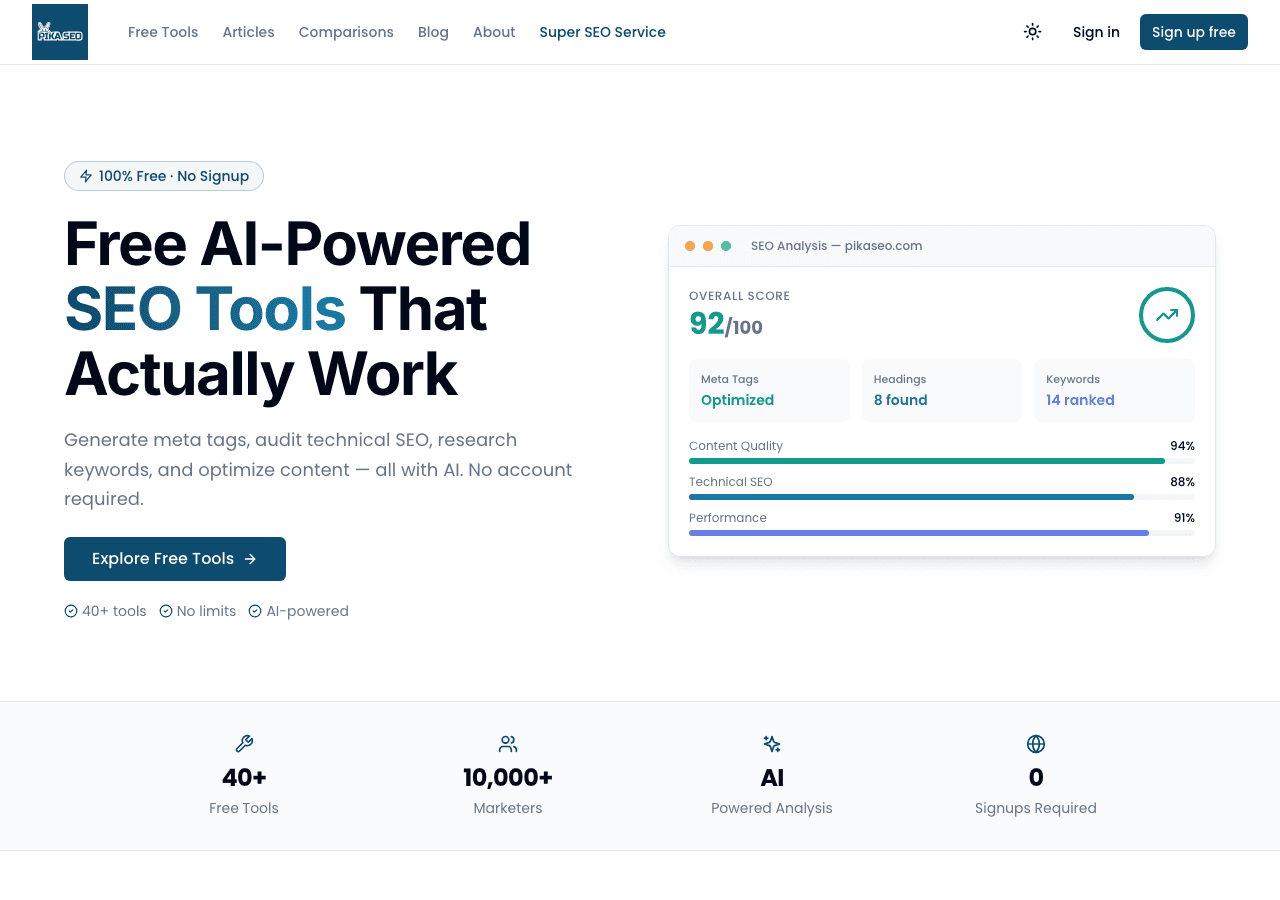
PikaSEO is the companion piece to a first-party workflow. Once your data shows what to fix, this is where the fixing gets done: a Meta Tags Generator with live SERP preview, a Technical SEO Audit that checks 30+ ranking factors including security headers and schema, a Long-Tail Keyword Generator with intent and difficulty, plus schema generators (FAQ, Article, Product, Local Business, Breadcrumb), a robots.txt and XML sitemap generator, an internal-link suggester, readability and heading analyzers, and an LLMS.txt generator for AI crawler visibility.
The "no signup" part is the differentiator at solo scale. Most free SEO tool sites are lead-capture funnels that gate the third result behind an email form. PikaSEO's whole pitch is open the tool, paste your content or URL, get the output — which makes it the thing you keep open in a tab during a content sprint.
Full disclosure again: PikaSEO is also from our ecosystem. The same rule applies — the tools are free to check against the claims yourself.
Pricing (September 2026): every tool is free with no limits. The only paid thing on the site is "Super SEO," a done-for-you service from $299 — that's an agency service, not a tool tier, and solo founders can ignore it.
Best for: Doing the actual on-page work — titles, meta descriptions, schema, internal links — at exactly $0, without creating an account.
Watch out: PikaSEO doesn't connect to GSC — it's a workbench, not analytics. And its keyword volume numbers are third-party estimates like everyone else's, so treat them as direction, not truth. The first-party truth still lives in Search Console.
3. Google Search Console — the most underrated tool on every list🆓
The only source of actual impression, click, and position data for your site in Google — free, first-party, and more accurate than every $139/month tool on this list.
GSC doesn't get ranked because nobody makes affiliate money sending you to a free Google product. But every serious workflow on this page is built on top of it. The Performance report shows the real queries real people typed where your site appeared — including hundreds of long-tail terms you'd never find with a keyword tool, because keyword tools model heads, not your tail.
The playbook that matters at solo scale: sort queries by impressions, filter to positions 8–20, and you're looking at pages Google already trusts enough to show — pushing those to page one is the cheapest traffic you will ever win. Add the URL Inspection tool, Core Web Vitals, and indexing reports, and you have the foundation of a real SEO operation for $0.
Pricing: Free, forever.
Best for: Every single person reading this. If you haven't verified your site yet, stop reading and do that first.
Watch out: The UX is clunky and the limits are real — the UI caps you at 1,000 rows, data goes back only 16 months, some queries get anonymized, and average position rounds across all URLs. That's exactly why tools like CrawlRaven, SEOgets, and SEOTesting exist: they're layers that make this data usable, not replacements for it.
4. SEOgets — GSC and GA4 dashboards that remove the spreadsheet work📊
The best pure analytics layer on Search Console — 50,000 rows instead of 1,000, every property in one dashboard, and a free tier with no click limits.
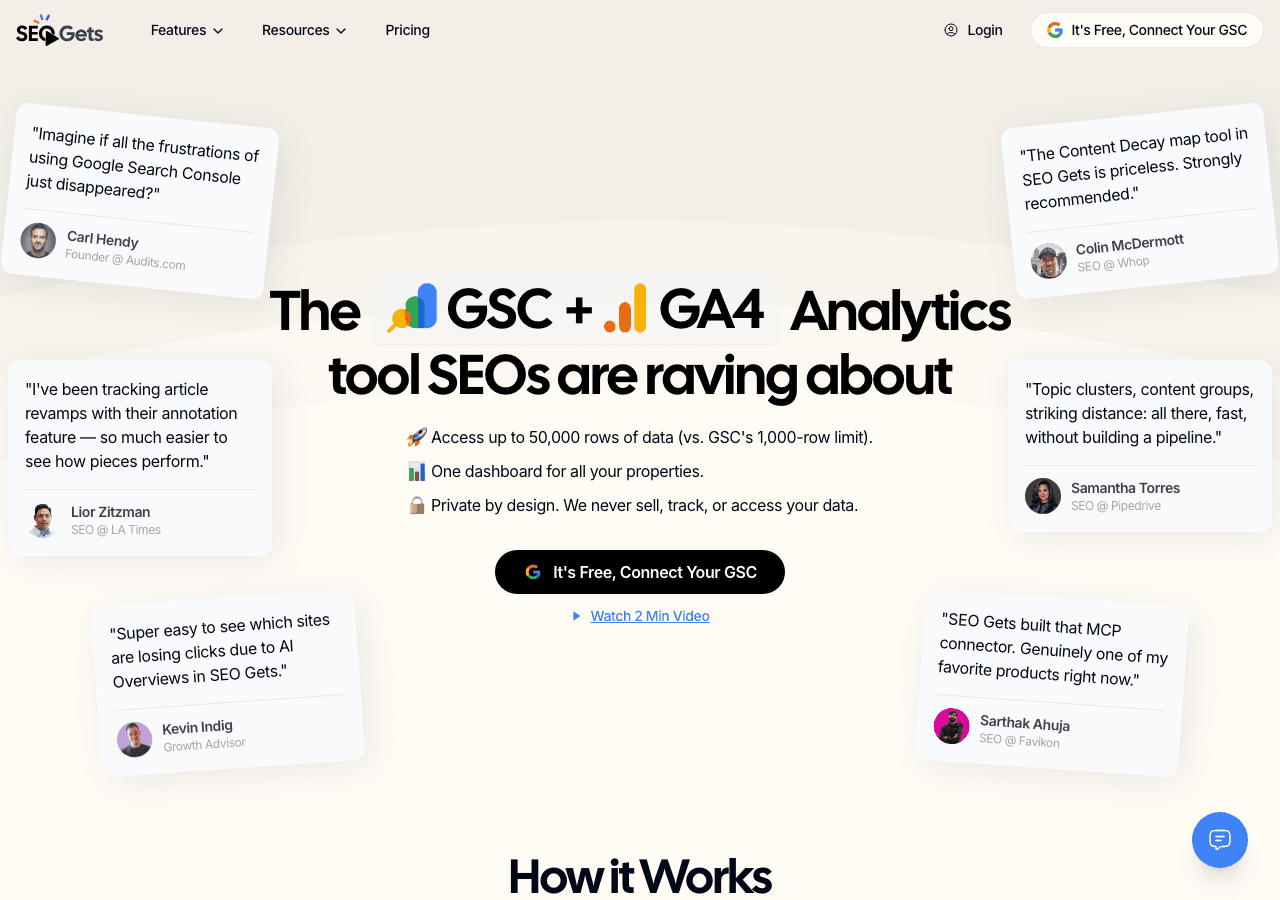
SEO Gets connects to your GSC (read-only) and, since January 2026, GA4 too — so clicks, impressions, and position sit next to sessions and engagement in one view. The master dashboard shows all your sites on one page, which is the killer feature once you run more than one project. Content groups and topic clusters, branded vs non-branded filtering, Google Core Update annotations, and content decay maps round it out.
The free tier is genuinely generous — unlimited sites, unlimited users, 50,000 data rows, and no click limits (those were removed in April 2025). Paid plans add GA4 dashboards, opportunity reports, SEO testing, an MCP connector, and up to 5 years of historical data versus GSC's 16 months.
Pricing (September 2026): Free. Core $39/month. Pro $49/month including one "Super Site" for extended storage; extra Super Sites $10/month each.
Best for: Multi-site operators and solo founders who live in their GSC data daily and want it fast and filterable without building a Looker Studio dashboard.
Watch out: It's your own data only — no competitor research, no backlinks (you still want #7 for that). And the paid tiers start at $39/month, which stacks up quickly next to CrawlRaven's one-time pricing if a ranked plan is what you actually need.
5. SEOTesting — prove what actually worked🧪
The tool for answering the question every founder asks after a content sprint: "did that even work?"
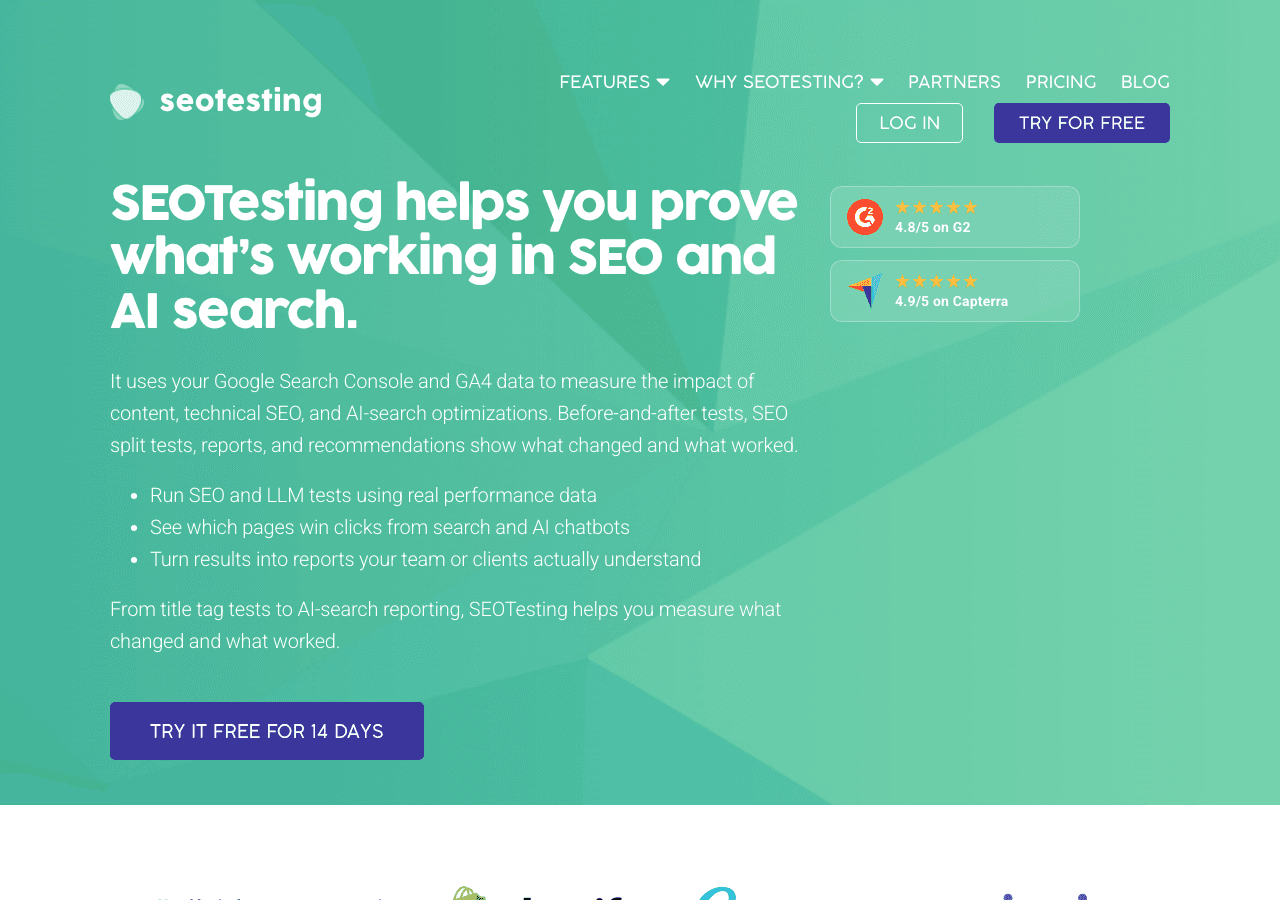
SEOTesting runs before/after tests on your GSC data — annotate a change (new titles, refreshed intro, added schema) and it tracks the clicks and impressions shift, with Google update timelines overlaid so you don't credit a core update to your own rewrite. It also does content-group testing, cannibalization reports, decay spotting, and a monthly written report that correlates your traffic shifts with your tests. The Capterra and G2 ratings sit at 4.9, and the case-study roster (Ooni, Decathlon) is real agency-grade.
It's first-party to the bone — built entirely on your Search Console and GA4 data, no estimates anywhere, and the founder has been in the GSC-tooling space for years (it's a product by SanityCheck.io Limited).
Pricing (September 2026): 14-day free trial (fully functional, up to 30 sites, no card), then $50/month for 1 website, $125/month for 5, $375/month for 20. Unlimited users on all plans.
Best for: Founders and small teams making deliberate, repeated changes — refreshes, restructures, template updates — who want statistical honesty about the results instead of vibes.
Watch out: No free tier, and $50/month is real money pre-revenue. If you're publishing your first 20 posts, a GSC dashboard plus CrawlRaven's free plan covers you; SEOTesting earns its keep once you have enough traffic for tests to be meaningful.
6. Screaming Frog — the technical crawler you graduate into🐸
The industry-standard desktop crawler — and its free tier is enough for most indie sites, forever.
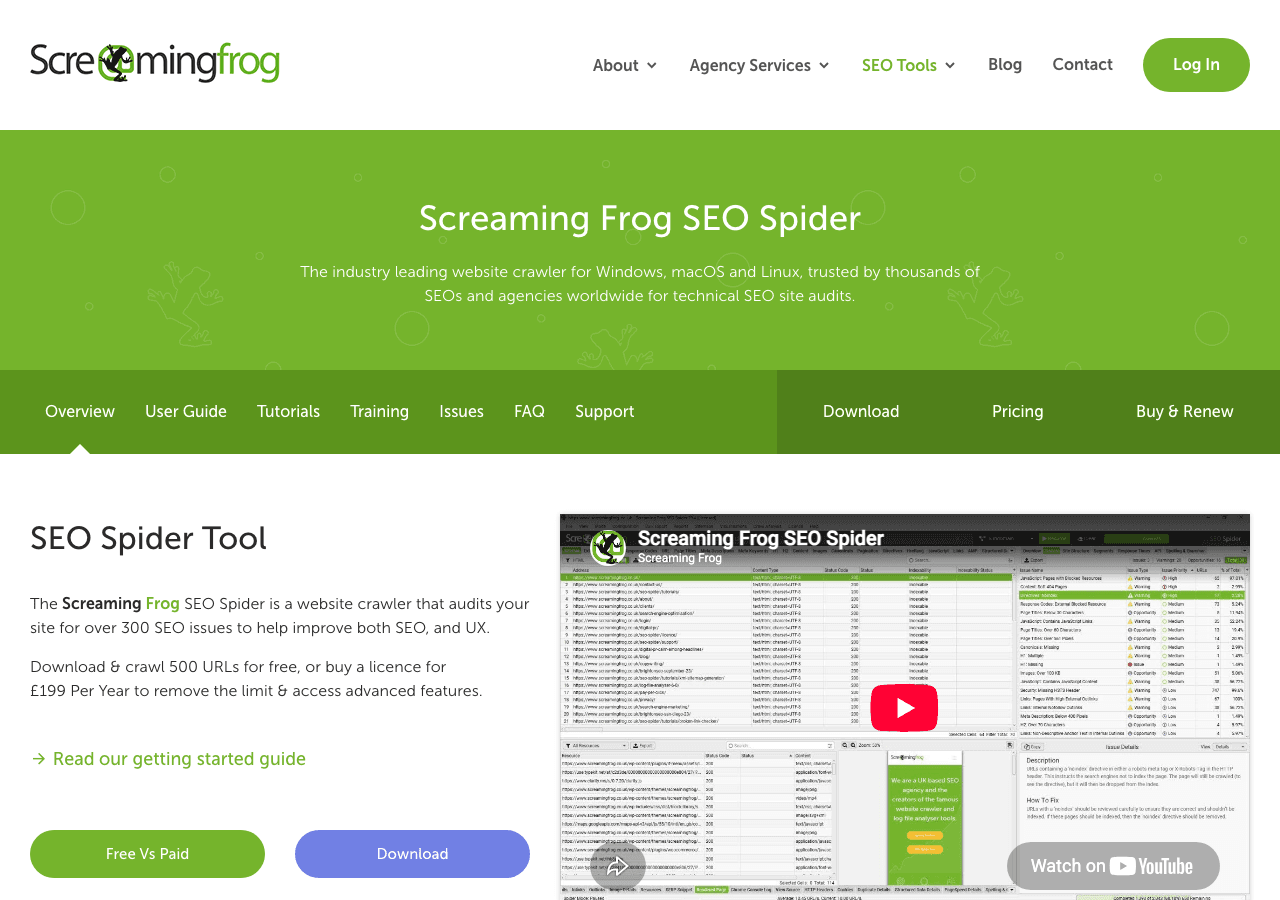
Screaming Frog crawls your site like Googlebot and surfaces broken links, redirect chains, duplicate titles, missing alt text, canonical conflicts, hreflang errors, and Core Web Vitals hooks. It's the tool agencies open first on a technical audit, and it's been the standard for over a decade.
Here's the part most listicles don't say: the free version crawls up to 500 URLs with no time limit, no signup, and no email capture. Most indie sites — a landing page plus a blog — fit inside that. The paid license matters when you cross 500 URLs or need JavaScript rendering, custom extraction, and scheduled crawls.
Pricing (September 2026): Free up to 500 URLs. Paid license £199/year (~$279) per user, with volume discounts from 5 licenses. It's a recurring annual license — skip renewal and you drop back to the free tier.
Best for: Technical audits once your site outgrows the browser-extension stage — especially JavaScript-heavy sites where a rendered-vs-raw HTML diff matters.
Watch out: It's a desktop app (Mac/Windows/Linux) with a 2010s UI and a real learning curve — it exports data, it doesn't tell you what to do next. Pair it with something that ranks the fixes. And per-user licensing means a team of three buys three licenses.
7. Ahrefs Webmaster Tools — your real backlink data, free🔑
Everything Ahrefs knows about your own site — backlinks, referring domains, site audit — for $0.
Ahrefs Webmaster Tools is the exception to my third-party rule. When Ahrefs crawls the web and reports the backlinks pointing at your verified site, that's not an estimate modeled from a clickstream panel — it's actual crawled link data about a domain you own, and it's free because you verified ownership. You get Site Explorer for your own domain, backlink and referring-domain tracking over time, and Site Audit for technical issues.
This is the right way to use Ahrefs' database at solo scale: the part that's real (crawled links) on the site that matters (yours), without the $129/month subscription.
Pricing (September 2026): Free, for sites you verify. No time limit.
Best for: Watching your backlink profile grow, spotting toxic links, and getting Ahrefs-grade site audits on your own properties at $0.
Watch out: Your own sites only — zero competitor visibility. The moment you want to research someone else's domain, you're in paid Ahrefs territory.
8. Ahrefs — the third-party database worth paying for (sometimes)🔗
The best web-scale index for competitor and backlink research — and the tool whose estimates are off by a median ~49%.
Both things are true, and an honest list says both. Ahrefs crawls a massive slice of the web, and for answering "who links to my competitor" or "what pages exist about X topic," nothing free comes close. Its own blog published the study I quoted in the intro: across 1,635 sites, its organic traffic estimates deviated from GSC by a median of 49.52%, with a 0.76 correlation. To Ahrefs' credit, they ran and published the study themselves — that transparency is why I trust their database and distrust their traffic numbers.
My honest take on the 2026 wrinkle: tools like this estimate traffic as rankings × CTR curves, and those curves were calibrated before AI Overviews started absorbing clicks. A model built on pre-AI click behavior is going to be even further off this year — another reason your own GSC data, which measures what actually happened, is the number to trust.
Pricing (September 2026): Starter $29/month (added January 2026 — limited rows and history, no Content Explorer or Rank Tracker). Lite $129/month, or ~$108/month annually, with 750 tracked keywords and 5 projects. No free trial on paid plans.
Best for: Competitor backlink research and content discovery once you have revenue to spend — the use case where a web-scale index genuinely beats first-party data, because your GSC can't see your competitors.
Watch out: It systematically underestimates small sites — that same study showed the deviation getting worse lower down the traffic curve. If Ahrefs says your site gets "50 visits/month" and GSC says 2,000 impressions, believe GSC.
9. Semrush — the all-in-one suite (for funded teams)🛰️
The broadest toolset on this list — and the most overestimated traffic data, at the highest entry price.
Semrush bundles keyword research, rank tracking, backlinks, site audit, PPC data, and social tooling in one platform. For an in-house team that needs everything under one login and has the budget, it's a defensible buy, and its keyword database for some markets is genuinely deeper than Ahrefs'.
But the numbers problem is the worst in class: the Collaborator.pro 184-site study put Semrush's average error at 61.58%, with a tendency to overestimate — one site in the study got ~134K estimated visits against ~50K real ones. If you size a content opportunity off Semrush numbers, you can easily conclude a competitor gets 2–3x the traffic it actually gets, and chase the wrong niche.
Pricing (September 2026): Pro $139.95/month, Guru $249.95/month, Business $499.95/month. Free tier is account-gated with heavily limited usage.
Best for: Funded startups and agencies that need the full suite and can afford to cross-check every estimate against GSC.
Watch out: For a solo founder, $139.95/month is $1,679/year — more than 40x CrawlRaven's lifetime license — for a tool whose traffic estimates are the least accurate of the big three. Use GSC for your own truth; only pay for Semrush if the PPC/social/competitor bundle justifies it.
Which one should YOU pick?🎯
Don't subscribe to five tools. Pick by situation:
- Starting from zero (no GSC yet) → Verify Search Console today, run your site through PikaSEO's free Technical SEO Audit, and fix what it finds. Cost: $0.
- You have GSC data but no plan → CrawlRaven's free plan (1 site), and grab the $39 lifetime license before the batch price steps up. This is the default recommendation for indie hackers.
- You run 3+ sites and want the analytics layer → SEOgets free tier, paid if you need GA4 dashboards and 5-year history.
- You make repeated changes and need proof → SEOTesting, once your traffic is big enough for tests to mean anything.
- Your site broke 500 URLs or is JavaScript-heavy → Screaming Frog (free until 500 URLs, £199/yr after).
- You want backlink visibility → Ahrefs Webmaster Tools free for your own site; pay for Ahrefs Lite only when competitor research becomes worth $129/month to you.
And the meta-advice: the stack that costs $0 — GSC + AWT + PikaSEO + CrawlRaven free — beats the $140/month stack for a solo site, because the expensive tools' flagship numbers are guesses and the free tools' numbers are measurements.
SEO itself compounds slowly, so pair this stack with distribution you control. Our first 100 users playbook covers the channels that work before you have rankings, and marketing your business for $0 has more free-stack thinking in the same spirit.
FAQ🙋
What's the best SEO tool in 2026?
For indie hackers, CrawlRaven is the top pick: it connects your Google Search Console and GA4, imports your keyword research, and returns one ranked plan of what to write, update, and fix — built on first-party data instead of estimates. It's free for one site, with lifetime licenses from $39 one-time. PikaSEO is the best free on-page toolset, and Google Search Console itself remains the foundation every stack should start with.
How inaccurate are Ahrefs and Semrush traffic estimates?
Ahrefs' own study of 1,635 websites found a median deviation of 49.52% between its traffic estimates and real Google Search Console data. A separate 184-site study by Collaborator.pro measured Ahrefs' average error at 48.63% (it tends to underestimate) and Semrush's at 61.58% (it tends to overestimate). The errors are largest for small sites, which both tools can show as near-zero traffic.
Can I do SEO with only free tools?
Yes. Google Search Console (real query and position data), Ahrefs Webmaster Tools (your backlink profile), PikaSEO (40+ on-page and content tools), and CrawlRaven's free plan (GSC insights for one site) cover most of what a solo founder needs. Screaming Frog's free tier handles technical crawls up to 500 URLs.
Do I need Semrush or Ahrefs as an indie hacker?
Not at first. Their strength is competitor research — backlink profiles and keyword lists for sites you don't own — which your first-party data can't see. Until competitor research is worth $129+ per month to you, use Ahrefs Webmaster Tools for your own backlinks and GSC for everything else, and pay for Ahrefs Lite only when revenue justifies it.
What's the cheapest way to make my Search Console data usable?
Google Looker Studio's native GSC connector is free and unlimited-ish for DIY dashboards. If you'd rather not build one: SEOgets' free tier gives you 50,000-row dashboards across unlimited sites, and CrawlRaven's free plan turns one site's GSC data into a ranked action list — with a $39 one-time lifetime license if you want to keep it.
Thank you for reading🙏
Every week I break down how real indie hackers build profitable internet businesses — the newsletter continues at Superframeworks.
Join here for weekly case studies and frameworks.
Cheers,
Ayush