
Indie Hackers Are Cloning Each Other’s SaaS. What Should You Build?
Marc Lou built a Beehiiv alternative, then makers targeted his DataFast. Here is what the cloning wave reveals about finding a real SaaS opening.
 Ayush Chaturvedi8 min read
On October 15, 2026, Marc Lou launched MailCheap, a newsletter platform he pitched as a cheaper Beehiiv alternative. Nine days later, after Marc celebrated DataFast's growth, other makers were pitching cheaper and free alternatives to his analytics product.
That is the new indie-hacker copying loop: you see a product working, build the part you need, and launch your version in public. Then someone does the same to you.
Should you join in? There is a real opportunity here. But the lesson is more useful than “clone a successful app.” Let's look at what these builders actually copied, what they left behind, and how to find an opening you can serve👇
What actually happened📰
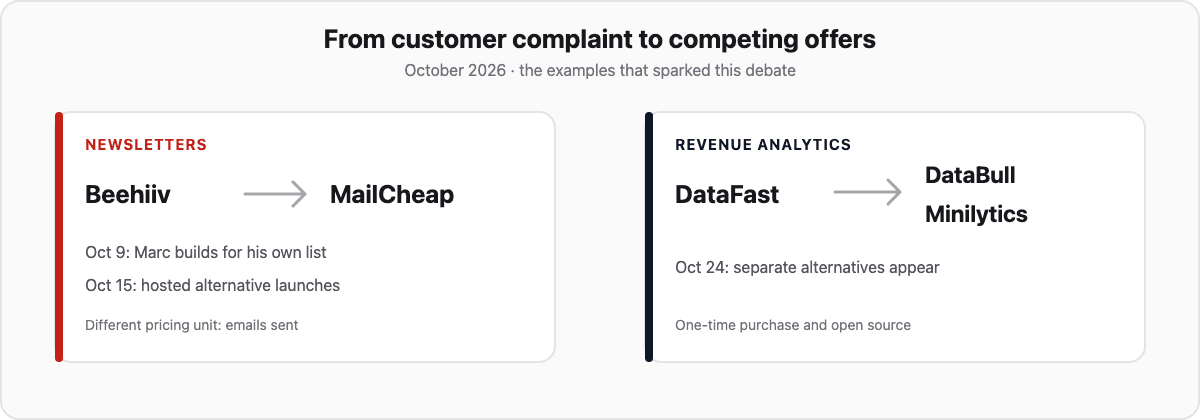
Marc's starting point was a bill. On October 9, he said he had built his own newsletter platform after facing a future Beehiiv charge of about $4,000 a year, up from roughly $1,000. He expected his own setup to cost less than $300 a year. Those are Marc's estimates for his use case, not a general price comparison.
On October 10, he released the self-hosted MailCheap code. It uses Amazon SES for sending and includes an editor, subscriber management, an archive, unsubscribes, and bounce handling. The repository estimates SES sending at about $0.10 per 1,000 emails. It also explicitly says there is no support for the open-source release; you must set up and maintain the database, domain, sending account, queue, and hosting yourself.
On October 15, he launched a hosted version. MailCheap's site advertises a plan from $19 a month and prices by emails sent rather than subscriber count. Its “83% cheaper” headline uses a particular example: 4,000 subscribers and one issue a week. A daily publisher or a team using Beehiiv's ad network, automations, and other tools needs a different comparison.
Then the roles flipped. On October 24, Marc said DataFast had taken eight months to reach $3,000 MRR and had since plateaued near $30,000 MRR. DataFast helps founders connect website visits to payments and see which marketing channels produce revenue. Its product site describes that revenue attribution workflow.
That same day, Ahmed Gagan promoted DataBull around the same job: showing which posts and traffic sources make money. His October 24 launch post offered it for $29 once; its live site now shows a higher one-time price. DataBull runs in the buyer's Cloudflare account, so the price and the operating responsibility differ from a hosted DataFast subscription.
Surendra Pandar also released Minilytics, an MIT-licensed, self-hosted analytics app whose README says it was inspired by DataFast. It offers a similar revenue-first dashboard on Cloudflare. The repository describes tracking limits, deployment steps, and payment attribution. The public evidence shows two makers responding to DataFast; it does not establish that Minilytics copied DataBull.
The conversation🗣️
Beehiiv CEO Tyler Denk gave the strongest counterargument in his October 20 newsletter. His point was that a newsletter is more than a screen for writing and a button for sending. There is delivery, spam prevention, subscriber verification, monitoring, support, and the ongoing work of improving those systems.
“But ‘building it’ is the easy part.”
That line is fair even if you disagree with Denk's tone or his conclusion about MailCheap. A working first send does not prove that thousands of other publishers can rely on the service every week. Equally, an incumbent's long feature list does not prove that every customer needs every feature.
Marc's open-source repository actually makes the trade clear. You can take the code for free and own the work. Or you can pay for the hosted product and ask someone else to own more of it. The same choice sits behind DataBull's one-time, self-hosted offer and Minilytics' open-source release.
The indie hacker angle: copy the complaint, then narrow it👇
Here is the pattern worth stealing: start with a specific customer complaint, then reduce one cost or frustration. Marc did not begin with a generic “build Beehiiv” spec. He wanted to send his own newsletter without paying for a large, mostly dormant list. Ahmed's pitch was similarly narrow: see which of his posts made money without a recurring analytics bill.
That gives you a better question than “which big app can I clone?” Ask: which part of the incumbent are a group of customers paying for but barely using? A simpler product can win those customers without matching the entire platform.
There are at least three positions in this one story:
- Managed and broad. Beehiiv and DataFast sell an ongoing service. The buyer pays every month for setup, new features, operations, and help. Their challenge is showing that continuing value to customers who only use a small slice.
- Managed and focused. Hosted MailCheap takes a narrower newsletter job and a different pricing unit. Its challenge is earning trust and maintaining deliverability as more customers arrive.
- Self-hosted and cheap. DataBull and Minilytics shift more work to the buyer in exchange for a one-time price or open-source code. Their challenge is making setup, updates, and attribution reliable enough for that audience.
These are different offers, even when the dashboard or editor looks similar. Do not compare the sticker prices until you have counted your own hosting, setup time, maintenance, and the features you actually use.
The speed of these launches also changes the risk for makers. If your whole pitch is the same feature for less money, another builder can lower the price again. The October sequence demonstrated that in public. A smaller codebase may make it easier to launch; it does not give you exclusive access to the customer.
Historical rhyme: the focused alternative📜
This is not the first time a smaller builder has looked at a mature product and picked one job to do better. AJ's Carrd did not set out to reproduce every website-builder feature. It made simple, responsive, one-page sites easy and affordable. The constraint was part of the product.
Tuple's founders found another opening after the screen-sharing workflow developers loved in Screenhero disappeared into Slack. They built for pair programmers with a particular frustration. The demand came from a lost workflow, not from the mere existence of a successful app.
MailCheap, DataBull, and Minilytics are younger stories. We cannot yet say which will retain customers or become durable businesses. What we can see is the same early move: find people who can describe exactly where an existing product disappoints them, then offer a deliberately smaller answer.
What to do about it this week✅
- Write down a bill you resent. Pick software you use yourself. Name the one outcome you need, the features you ignore, and the amount you pay. That is a hypothesis, not a market yet.
- Find five more people with the same complaint. Ask what they use today, what they have tried, and what would make them switch. Do not count likes on your launch thread as customer interviews.
- Choose a service boundary. Will customers host your code, or will you run it? Write down who owns updates, backups, support, security, and failures. Put that boundary on the pricing page.
- Build one complete workflow. For newsletters, that includes sending, unsubscribing, and handling bounces. For revenue analytics, it includes tracking a visit, matching a payment, and explaining when attribution fails. A pretty dashboard alone is a demo.
- Get the first ten users through the complaint. Show the before-and-after cost or time for a real use case. The first 100 users playbook has more ways to find those early customers without an existing audience.
One caution: copying a workflow does not require copying a competitor's code, brand, or customer data. Build from the customer problem and your own implementation. The aim is to give a distinct group a better deal they can understand and trust.
Marc proved that even a founder with a fast-growing product can be the next target. That makes the opportunity real—and the work after launch more valuable.
Related links🔗
- Marc Lou's MailCheap launch and the self-hosted repository
- Tyler Denk's response on the work behind newsletter software
- Marc's DataFast milestone, plus DataBull and Minilytics
Thank you for reading🙏
Every week I break down how real indie hackers build profitable internet businesses — the newsletter continues at Superframeworks.
Join here for weekly case studies and frameworks.
Cheers,
Ayush